Interpretation and significance

Selected Contributions

These works were selected because they changed the statistical formulation of an astronomical problem, produced reusable scientific infrastructure, supplied a substantive synthesis, or established a specific physical result. The list is interpretive and deliberately selective. The Publications page retains the complete scholarly record.

Statistical models and inference

2015

Generalized linear models matched to astronomical observables

Binary events, positive measurements, and overdispersed counts encode different relations between an observable and its expected value. The three-paper series used binomial, gamma, and Bayesian negative-binomial models for primordial star formation, photometric redshifts, and globular-cluster populations. Each analysis made the sampling assumption explicit and estimated effects on the scale appropriate to the data.

2015

COSMOABC

Cosmological simulations can generate cluster-count catalogues even when the corresponding likelihood is impractical to evaluate. COSMOABC used population Monte Carlo approximate Bayesian computation to compare simulated and observed summaries and recover constraints on the cosmological parameters. The software made the likelihood-free calculation reproducible and available beyond the original analysis.

2017

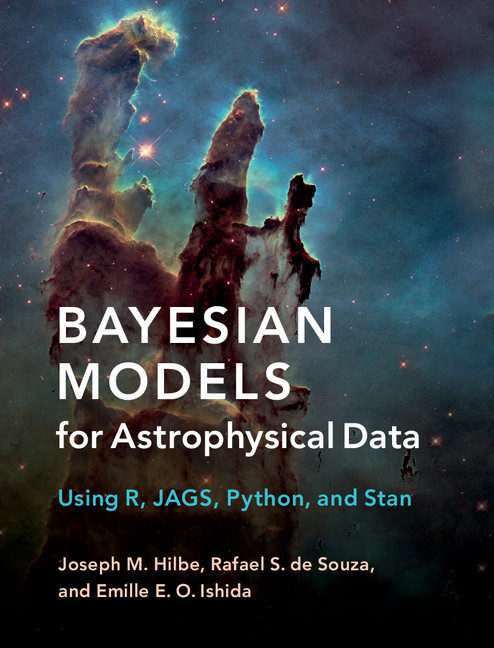
Bayesian Models for Astrophysical Data

The 408-page volume develops generalized, hierarchical, and likelihood-free models through complete astronomical analyses in R/JAGS and Python/Stan. Its contribution is a connected practical treatment of models that are often taught separately, with the assumptions and computation carried through to the scientific interpretation. The book received the 2018 PROSE Award in Cosmology & Astronomy.

Cover of Bayesian Models for Astrophysical Data
Cambridge University Press, 2017.
2020

Hierarchical Bayesian thermonuclear reaction rates

Measurements of the same nuclear reaction share the physical rate but carry experiment-specific normalisations and statistical errors. A hierarchical model estimated these terms jointly for the ⁷Be(n,p)⁷Li reaction. Below 1 GK, the analysis obtained rate uncertainties of 1.5–2.0 per cent and found that commonly used rates were overconfident because they did not propagate all sources of uncertainty.

Surveys, sampling, and representation

2017

Realistic validation of photometric redshifts

A spectroscopic calibration set can fail in two distinct ways: it may not cover the target colour–magnitude space, or its measurement errors may differ within regions that are covered. Teddy and Happy separated these mechanisms in controlled catalogues. The resulting tests showed where machine-learning photometric-redshift estimates failed through extrapolation and where they failed because the conditional photometric distribution had changed.

2019–2020

Active learning and RESSPECT

Spectroscopic follow-up was formulated as sequential label acquisition under a finite telescope budget. The candidate pool and classifier changed after each observation, while the acquisition rule accounted for uncertainty and object-dependent observing cost. In the realistic experiments, uncertainty sampling improved on random selection; the tested batch strategies produced no significant further gain.

2023

Graph-based ordering of Type II supernova spectra

A graph connected 1,595 spectra from 145 Type II supernovae according to spectral similarity. The resulting organisation exposed outliers and continuous evolution without imposing a fixed class boundary. Spectra changed rapidly near maximum light and became more homogeneous toward the end of the plateau, identifying phases at which a single subtype label conceals different amounts of spectral variation.

Astronomical structure

2021

SPICY and a high-pitch-angle structure in the Sagittarius arm

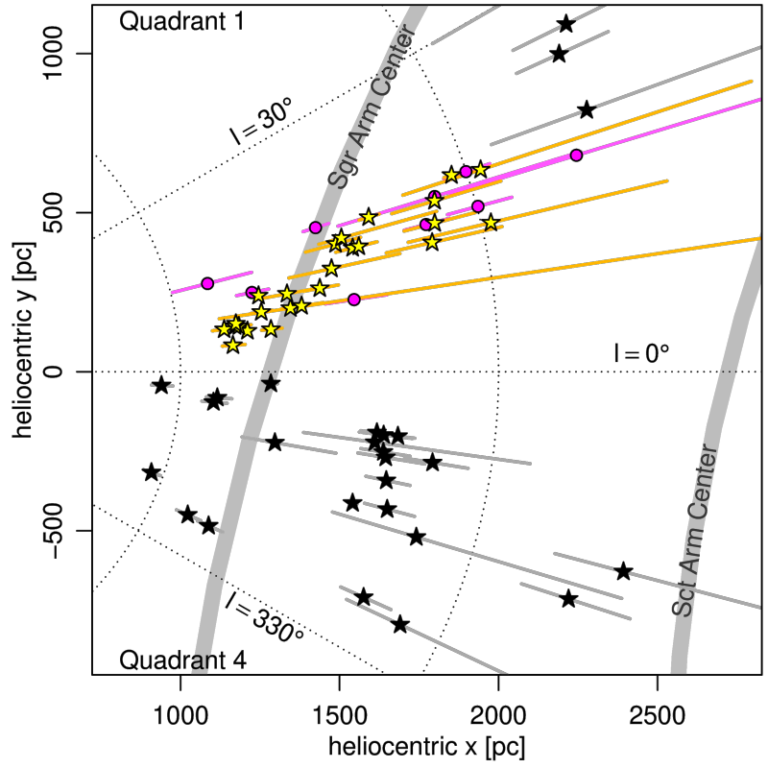
SPICY assembled roughly 120,000 candidate young stellar objects from infrared photometry. A subsequent analysis used the catalogue to identify 25 star-forming regions in a narrow structure about 1 kpc long. Its pitch angle of about 56 degrees differs from the smaller pitch angle usually assigned to the Sagittarius arm, so the feature cannot be treated as a simple continuation of a low-pitch-angle logarithmic arm.

Heliocentric map of young stellar object groups and Galactic spiral-arm references
Kuhn et al. (2021), A&A 651, L10, Fig. 3: YSO groups, spiral-arm references, and the fitted high-pitch-angle structure in heliocentric coordinates.
2025

CAPIVARA

Integral-field spectra vary across a galaxy, but fixed apertures and signal-to-noise bins need not follow changes in the stellar continuum or emission lines. CAPIVARA groups spaxels by spectral similarity and returns the groups to their positions in the galaxy. In five MaNGA systems, the resulting regions were coherent in continuum and emission-line properties without requiring a predetermined morphological decomposition.
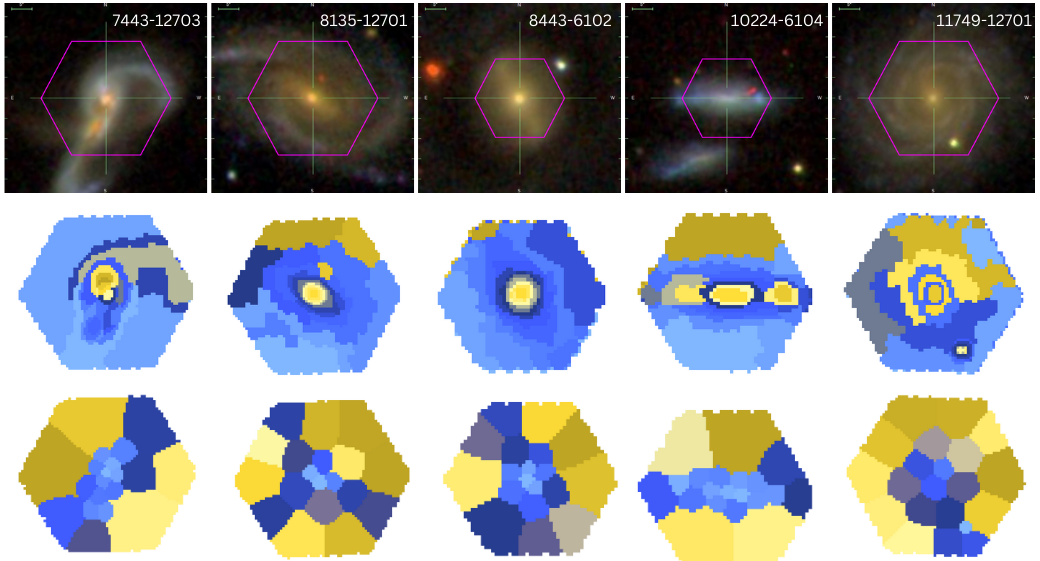
Galaxy images and CAPIVARA spectro-spatial segmentation maps
de Souza et al. (2025), MNRAS, top and middle rows of Fig. 2.

Additional milestones: DRACULA and Type Ia spectral diversity · DES weak-lensing ridges · SCONCE on spherical and conic geometries

See the complete publication record